Sale ends 6 May! Save £50pp with code SUMMER50

Santorini at a glance

Renowned for spectacular sunsets, stunning beaches, and volcanic beauty, incredible Santorini curves around a giant, breathtaking lagoon in the Cyclades Islands.

Imagine a relaxing getaway on an island of idyllic whitewashed villages, blue-domed churches, perfect blue skies, and the most incredible sunsets, and you'll be picturing a holiday in Santorini.

View prices

Book Now Holidays to Santorini

Fancy an Island Hop? Santorini Island Hopping

Destination Profile

The image of your Santorini holiday package will live on in your memory long after you've returned home. Said to be the Lost City of Atlantis, this unique, crescent-shaped island was formed by an ancient volcanic eruption around 1650 BC and possesses the most breathtaking views to be found on the Greek islands. So, what are you waiting for? Explore our selection of cheap holidays to Santorini, Greece.

Santorini really is a must-visit holiday destination and one everybody should add to their bucket list for its picture-perfect credentials. Take our expert Santorini holiday packages, sprinkle in some unforgettable experiences and you’ve got the perfect Greek holiday.

The island's volcanic past has resulted in a coastline of dark sandy beaches and the most spectacular interior imaginable. You won't find golden sandy beaches in Santorini, you’ll find grey sand paradises with tranquil seas bordered by striking backdrops of jagged cliffs. Seek out the towns of Kamari and Perissa and take some time out on the dramatic black sand beaches which can be found there. Kamari has been given blue flag beach status, and Perissa beach is the ideal location for water sports in Santorini.

Holidays to Santorini are perfect for those looking for a romantic getaway. It's an island perfectly crafted for weddings and honeymoons, with its breathtaking backdrops, beautiful beaches, and impossible sunsets. Santorini is famous too for its ancient ruins and archaeological heritage, and the Akrotiri Excavation Sites provide a lot for those looking to learn more about the island's fascinating history. So, whether you're looking for relaxation, romance or cultural enrichment, rest assured there is much to see and do for everyone on a Santorini holiday.

So, whether you're looking for relaxation, romance or cultural enrichment, rest assured there is much to see and do for everyone on Santorini holidays. As the Island Specialists, Olympic Holidays are proud to be the ones to assist holidaymakers with their package holidays to Santorini every year.

Make the most of your trip Things to see & do

Weddings

If you're looking for a fairytale wedding, Santorini is the dream pick. An island made for romance and beauty which is sure to satisfy anyone's desires for the perfect ceremony, anniversary or honeymoon.

To get more information, call our weddings team on:
020 8492 6789

When is the best time to visit Santorini?

The Mediterranean climate features a warm, dry summer, and the hottest months in Santorini are July and August when temperatures reach 27 C. For those who wish to visit in the slightly cooler months, the best time to visit will be in May, June and September. This also has the added bonus of being a quieter time of year in terms of tourism.

Volcano Info

Did you know that the whole complex of Santorini islands is still an active volcano, the same as Méthana, Mílos and Nísiros, and probably the only volcano in the world whose crater is in the sea? The islands that form Santorini came into existence as a result of intensive volcanic activity; twelve huge eruptions occurred, approximately one every 20,000 years, and each violent eruption caused the collapse of the volcano’s central part, creating a large crater, or caldera. The volcano, however, managed to recreate itself over and over again.

The last big eruption occurred 3,600 years ago, during the Minoan Age, when igneous material, mainly ash, pumice and lava stones, covered the three islands: Thíra, Thirassiá and Asproníssi. The eruption destroyed the thriving local prehistoric civilisation, evidence of which was found during the excavations of a settlement at Akrotíri. The solid material and gases emerging from the volcano’s interior created a huge “vacuum” underneath, causing the collapse of the central part and the creation of an enormous “pot”, today’s caldera, with a size of 8 x 4 km and a depth of up to 400m below sea level.

Santorini Island consists of a semicircular archipelago of volcanic islands located in the southern Aegean Sea, between the islands of Ios and Anafi. In Greek, Santorini is also known as Thira or Thera. Santorini is a part of the Cycladic group of islands. The area of the island is 96 sq km, whereas the coastline surrounding the island stretches for almost 69 km. The capital of Santorini is Fira and the entire population is about 13,500 people. The main port of this island is Athinios and it gets extremely busy in summer.

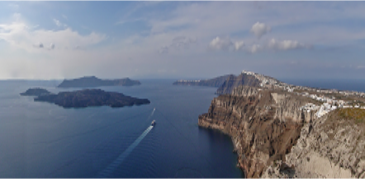
This island has always been subjected to volcanic eruptions from ancient times. The view of the giant caldera and the impressive geology of Santorini Island reveals the dreadful volcanic activity that took place in the past. The best example of Santorini’s geography is the famous caldera, which is strongly connected to the history of the island. Circular in shape, this caldera is entirely filled with water. In fact, it is the only sunken caldera in the world. It resembles a lagoon, as the water depth here is 400 metres. This caldera is surrounded by gigantic cliffs, on top of which beautiful villages have been constructed.

According to geologists, the first known eruption took place in the year 1,645 BC. This eruption was responsible for the tsunami waves that hit the northern coasts of Crete and destroyed the Minoan civilisation that flourished at that time. It is also speculated that the seismic activity of Santorini volcano could be an explanation for the Exodus of Moses and the Jews from Egypt.

For almost 1,300 years after that eruption, the volcano was completely inactive. Later on, with its minor eruptions, it created the islands of Palea Kameni, Mikra Kameni, Macronisi, Aspronisi and Nea Kameni. The last serious eruption happened in 1957, when the earthquake destroyed many houses and public buildings on the island. Since then, the volcano of Santorini has always alerted scientists and geologists with startling proof of seismic activity down the years.

This extreme volcanic activity has formed the culture and architecture of the island. The villages of Santorini are perched on the edge of the caldera and give breathtaking views of the sea. In fact, you can try trekking from Fira to Oia and enjoy the wonderful landscape of the island.

 

Beaches

Here’s a guide to some of the top beaches across the island here in Santorini.

  1. Perissa Beach: Known for its black sand and crystal-clear waters, Perissa Beach is lined with beach bars, restaurants and water sports facilities.
  2. Kamari Beach: Another popular black sand beach, Kamari offers a lively atmosphere with a variety of beachfront cafes, tavernas and shops.
  3. Red Beach: Famous for its dramatic red cliffs and dark red sand, Red Beach is a must-visit for its stunning natural beauty.
  4. White Beach: Accessible only by boat or by hiking, White Beach is known for its white cliffs and clear turquoise waters, offering a secluded and picturesque setting.
  5. Vlychada Beach: Characterised by its unique lunar landscape, Vlychada Beach features towering white cliffs and shallow waters, perfect for swimming and sunbathing.
  6. Monolithos Beach: Ideal for families with children, Monolithos Beach has shallow waters and a playground, as well as beachfront tavernas serving local cuisine.
  7. Amoudi Bay: Located below Oia, Amoudi Bay is known for its crystal-clear waters, picturesque fishing boats and fresh seafood tavernas.
  8. Agios Georgios Beach: A quiet and peaceful beach near Perivolos, Agios Georgios offers sunbeds, umbrellas and a relaxed atmosphere.

These are just a few of the many beautiful beaches Santorini has to offer. Each beach has its own unique charm and amenities, making it worth exploring different parts of the island to discover your favourite spot.

Santorini History

According to research and excavations on Santorini, the first human presence on the island dates back to the Neolithic Period. Santorini hosted an important civilisation around 3600 BC.

Discoveries made in an important city near Akrotiri and the famous Red Beach show the existence of an ancient Minoan colony. The city was very similar to those found on the island of Crete, with many wall ornaments and pottery showing naturalistic landscapes of animals and humans in the same ancient Minoan style.

In ancient times, Santorini Island was known as Strongili, which means round in Greek. Strongili was the victim of an enormous volcanic eruption in 1,500 BC. The eruption was so huge that many consider it to be the main cause of the destruction of the great Minoan civilisation on the island of Crete, situated 70 nautical miles away.

Specialists believe that the explosion was so strong that it created gigantic waves that reached the shores of the surrounding islands and Crete. After the explosion, the centre of Santorini sank, and the many earthquakes that followed destroyed a large part of the rest of the island.

Many studies and pieces of research have been presented today about the volcano of Santorini, including a series of documentaries by National Geographic. In some ancient myths, the destruction of the island is closely associated with the legend of Atlantis.

According to history, Phoenicians settled on ancient Thera around 1,300 BC and stayed for five generations. Then, around 1100 BC, the island was occupied by the Lacedaemonians. Around 825 BC, the inhabitants of the island, then named Thera, were using the Phoenician alphabet.

In the 7th and 6th centuries BC, Thera had commercial and trade relations with most of the islands and cities of Greece. During the Hellenistic Period, Thera, because of its central position in the Aegean, became an important trade centre and an important naval base, due to its strategically perfect position.

Between AD 1200 and AD 1579, the island was under Byzantine rule and the church of Episkopi Gonia was founded. In AD 1204, the island was surrendered to the Venetian Marco Sanudo and became part of the Duchy of the Aegean.

The name of the island was given by the Venetians after Santa Irini, the name of a Catholic church. During that time, there was a strong battle between Venetians and pirates.

During Turkish rule, from 1579 to 1821, the island succeeded in trading development with the ports of the Eastern Mediterranean. The period that followed was quite prosperous.

Further information about Santorini

Why should you go on a holiday to Santorini, Greece?

Santorini, officially known as Thira, is a beautiful island of stunning natural beauty in the exquisitely clear waters of the Aegean Sea southeast off the mainland of Greece. There are so many things that make holidays to Santorini so special.

Quaint whitewashed buildings, charming villages, archaeological sites, spectacular scenery, a delightful Mediterranean climate, and plenty of postcard-worthy beaches make Santorini the perfect holiday destination.

Rising high above sea level, the cliffs around the capital of Fira offer views that will never be forgotten, and its whitewashed houses are among the most photographed in Greece.

Every evening the sky over Fira burns bright with colour as the sun goes down. There are no beaches to be found here, but the location still affords visitors stunning views across the Aegean Sea.

There are some great views to be had from Fira, however the best view on Santorini can be found from the village of Oia, on the island's northern tip. We suggest you arrive early, take your seat outside a taverna, and drink in the view of a lifetime.

Santorini Travel Advice

Airports/flights: We fly from numerous UK airports to Santorini Airport. Flights take around 3 hours, 45 minutes from Gatwick.

Bus: Frequent bus services are available throughout the island connecting the villages of Santorini with Fira.

Car: An excellent way of getting around during Santorini holidays.

Boat: There are direct ferries leaving from Santorini to Ios (1 hr) and Crete (6 hrs) with connecting ferries Paros (3hrs) and Mykonos (5hrs)

Frequently Asked Questions

What airport do you fly into in Santorini?

You will fly into Santorini Airport (JTR). You can also add a shuttle transfer or private taxi to take you straight to your accommodation.

Is Santorini walkable?

Santorini is a large island with many different lovely areas to explore. The neighbourhoods themselves, (such as Oia and Fira) are very walkable. To travel between the various areas of the island it is recommended to take a car or public transport. There are buses which operate in between the opposite ends of the island.

What is the currency in Santorini?

Only Euros are accepted throughout mainland Greece as well as the islands of Greece, including Santorini. There are areas on the island to exchange GBP to Euros, or holidaygoers can convert their currency before departing from the UK.

How many days in Santorini is enough?

A minimum of seven days in Santorini is recommended for exploring the sights, trying the various beautiful beaches, getting the chance to catch a boat tour, taste some Greek food and wine, and do some shopping. Santorini is a large island with many things to do and see. Three to four days will provide a good taste of what Santorini has to offer, with some time to relax and grab souvenirs. Those looking for even more variety in their Greek holiday will adore our island hopping packages.

What is the best month to visit Santorini?

June to August is the period to go if you're looking to go when the nightlife is liveliest and the sea is warmest. April, September and October are good months to go if you're looking for less crowds and better prices. The island is slightly cooler during these months, but still much warmer than the UK.

Where to stay Santorini

Akrotiri

Akrotiri

Littered with olive groves and vineyards the surrounding countryside is simply a feast for the senses.

Fira

Fira

Fira is perched on the edge of an impressive cliff 260 metres high and offers a great panorama over the submerged volcano.

Imerovigli

Imerovigli

Imerovigli village is the highest point of Santorini giving it panoramic views of the island and the blue domed churches.

Kamari

Kamari

Kamari, nestled in the back drop of Mesa Vouno, is located just 10 minutes from the airport, on the south eastern side of the island.

Oia

Oia

The village of Oia perches on 700-foot high volcanic sea cliffs and is the second largest town in the island.

Perissa

Perissa

The village of Perissa is one of the most beautiful resorts on the island, and is popular for its dark, sandy beaches.

Perivolos

Perivolos

The picturesque beach of Perivolos is ideally located in close proximity to Perissa which is a mere 3 kms away.

Pyrgos

Pyrgos

At the highest point of the island and only 8 kms from Fira, is situated Pyrgos. Ideal for those seeking history and culture.

Vlychada

Vlychada

Set in the southern part of Santorini, Vlichada is a long black beach backed by dramatic white cliffs.

Firostefani

Firostefani

Often seen as an extension to Fira, Firostefani boasts some of the most magnificent views over the caldera.

Finikia

Finikia

A traditional Greek village in northern Santorini nearby Oia.

Megalohori

Megalohori

A paradise of wine. The three most important wineries of the island are located here: Boutaris, Antoniou, Gavalas. You will have the chance to savour the unique volcanic taste and sea aromas, and initiate into a thousand-year history of wine poetry.

Exomitis

Exomitis

The small and quiet resort of Exomitis is located in the southernmost part of the Greek island of Santorini, at Cape Exomitis.  

Vourvoulos

Vourvoulos

Vourvoulos is a small, quiet village located on the north east part of Santorini, about 4 kilometers from the capital Fira. It is built amphitheatrically on a slope that overlooks the east region of the island with the broad plains. The panorama from Vourvoulos...

Ex Gonia

Ex Gonia

Exo Gonia is a quiet, traditional village nestled on the southeastern slopes of Santorini. Known for its authentic Cycladic architecture, panoramic sea views, and historical charm, it offers a peaceful retreat away from the crowds. Visitors enjoy local tavernas,...

Date last updated: