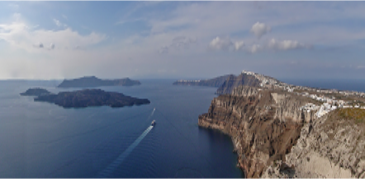
Did you know that the whole complex of Santorini islands is still an active volcano, the same as Méthana, Mílos and Nísiros, and probably the only volcano in the world whose crater is in the sea? The islands that form Santorini came into existence as a result of intensive volcanic activity; twelve huge eruptions occurred, approximately one every 20,000 years, and each violent eruption caused the collapse of the volcano’s central part, creating a large crater, or caldera. The volcano, however, managed to recreate itself over and over again.
The last big eruption occurred 3,600 years ago, during the Minoan Age, when igneous material, mainly ash, pumice and lava stones, covered the three islands: Thíra, Thirassiá and Asproníssi. The eruption destroyed the thriving local prehistoric civilisation, evidence of which was found during the excavations of a settlement at Akrotíri. The solid material and gases emerging from the volcano’s interior created a huge “vacuum” underneath, causing the collapse of the central part and the creation of an enormous “pot”, today’s caldera, with a size of 8 x 4 km and a depth of up to 400m below sea level.
Santorini Island consists of a semicircular archipelago of volcanic islands located in the southern Aegean Sea, between the islands of Ios and Anafi. In Greek, Santorini is also known as Thira or Thera. Santorini is a part of the Cycladic group of islands. The area of the island is 96 sq km, whereas the coastline surrounding the island stretches for almost 69 km. The capital of Santorini is Fira and the entire population is about 13,500 people. The main port of this island is Athinios and it gets extremely busy in summer.
This island has always been subjected to volcanic eruptions from ancient times. The view of the giant caldera and the impressive geology of Santorini Island reveals the dreadful volcanic activity that took place in the past. The best example of Santorini’s geography is the famous caldera, which is strongly connected to the history of the island. Circular in shape, this caldera is entirely filled with water. In fact, it is the only sunken caldera in the world. It resembles a lagoon, as the water depth here is 400 metres. This caldera is surrounded by gigantic cliffs, on top of which beautiful villages have been constructed.
According to geologists, the first known eruption took place in the year 1,645 BC. This eruption was responsible for the tsunami waves that hit the northern coasts of Crete and destroyed the Minoan civilisation that flourished at that time. It is also speculated that the seismic activity of Santorini volcano could be an explanation for the Exodus of Moses and the Jews from Egypt.
For almost 1,300 years after that eruption, the volcano was completely inactive. Later on, with its minor eruptions, it created the islands of Palea Kameni, Mikra Kameni, Macronisi, Aspronisi and Nea Kameni. The last serious eruption happened in 1957, when the earthquake destroyed many houses and public buildings on the island. Since then, the volcano of Santorini has always alerted scientists and geologists with startling proof of seismic activity down the years.
This extreme volcanic activity has formed the culture and architecture of the island. The villages of Santorini are perched on the edge of the caldera and give breathtaking views of the sea. In fact, you can try trekking from Fira to Oia and enjoy the wonderful landscape of the island.