


Where to Stay in Corfu: A Guide to the Best Areas for 2026
Corfu is one of the largest islands in the Ionian Sea, with a green, hilly interior and four distinctly different coastlines: a sheltered east, a sandy north, a dramatic west and a livelier south. That range is why picking the right base matters so much here. Where you choose to stay shapes the whole feel of your holiday to Corfu.
This guide breaks down the best areas of Corfu one by one, so you can match the resort to the kind of trip you actually want, rather than picking a name off a map. Whether you'd rather be based in one of the best towns in Corfu or somewhere quieter, that same choice comes up in almost every section below.
Where to Stay in Corfu: At a Glance
-
Corfu Town is the best base for history, restaurants and year-round appeal, though it has limited sandy beach access on its doorstep.
-
Dassia, Gouvia, Ipsos and Nissaki on the east coast suit families and couples who want calm, sheltered water and short transfer times.
-
Sidari, Roda and Acharavi on the north coast are known for flatter, family-friendly beaches with a good range of amenities.
-
Paleokastritsa, Agios Gordios and Glyfada on the west coast are the pick for dramatic scenery and some of Corfu's best beaches.
-
Kassiopi and the northeast coast (including Kalami and Agni Bay) suit couples and quieter travellers who want a more authentic, low-key base.
-
Kavos in the south is Corfu's main nightlife resort, popular with groups and younger travellers.
Why Visit Corfu? What to Know Before You Decide Where to Stay
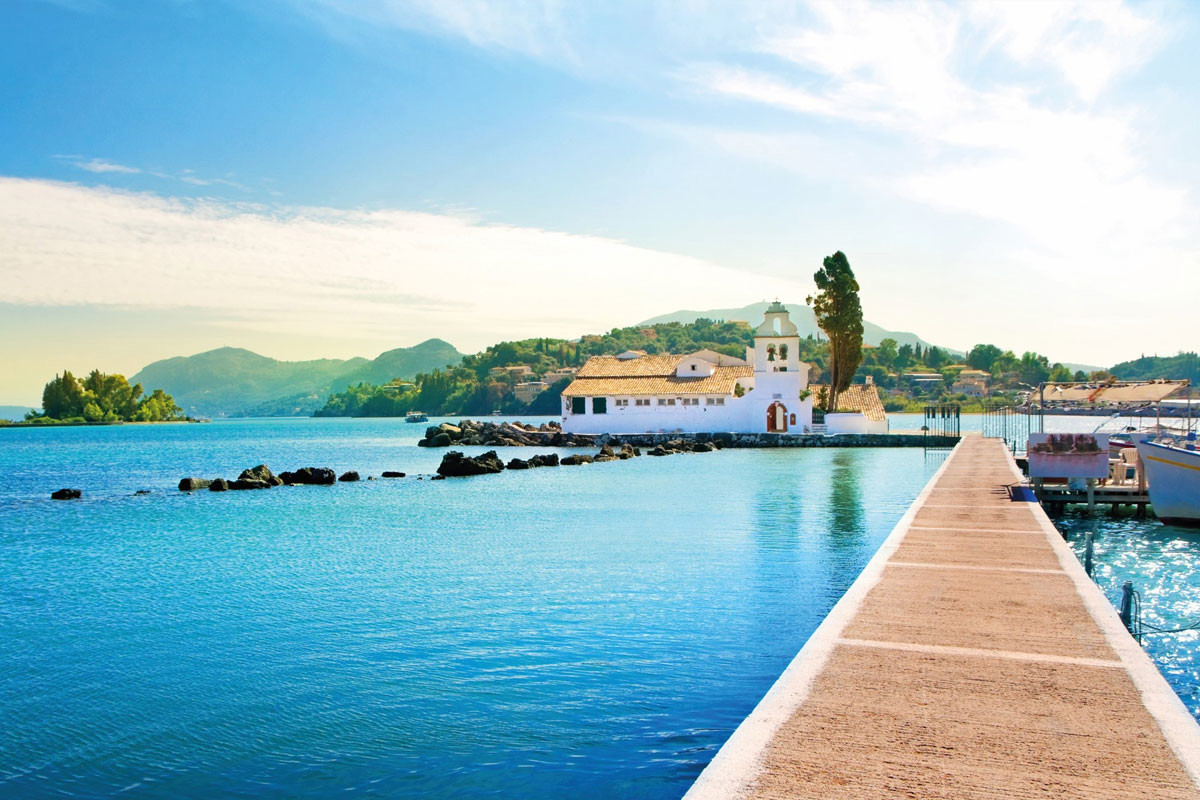
Corfu is one of Greece's greenest islands, with a hilly, wooded interior that sets it apart from the drier, rockier look of many Cyclades islands. Its coastline runs to roughly 217 kilometres, with more than 50 beaches spread across it, so there's real variety within a single island rather than needing to hop between several for a change of scenery.
Summers here are reliably warm, with average temperatures around 30°C between May and October. The island also stays milder for longer into the shoulder months than some Aegean destinations, which is part of why Corfu Town in particular works well outside peak summer.
Once you've settled on Corfu itself, the next decision is which coast suits your trip, and that's what the rest of this guide covers area by area.
Corfu Town: Where to Stay for History and Nightlife
Corfu Town is the best base if you want history, restaurants and a genuine town atmosphere within walking distance of your accommodation, particularly for couples and travellers who don't want the trip built entirely around a beach.
What it's like: The Old Town was made a UNESCO World Heritage Site in 2007, recognised for its Venetian-era forts and streets that blend Venetian, French and British influences from four centuries of different rule. Much of the town's character comes from that layered history rather than from any single beach.
Good to know: Beach access is the main trade-off. You'll need a short drive or bus ride to reach a proper stretch of sand, with Kanoni and Perama both a short distance away on the edge of town. The upside is that restaurants and bars stay open well into the shoulder months, which makes Corfu Town one of the better choices if you're travelling outside peak summer.
What to do: Wander between the two Venetian fortresses, explore the Old Town's narrow streets and squares, and use the beaches at Kanoni and Perama as an easy day-trip option rather than a doorstep one.
Accommodation options in and around the Old Town are listed on our Corfu Town page.
East Coast Corfu: Where to Stay for Calm Water and Easy Transfers
For families who want calm water close by, the east coast is usually the strongest option. Dassia, Gouvia, Ipsos and Nissaki all sit on a stretch of coastline that's more sheltered than the north or west, so the sea tends to be calmer for younger swimmers.
What it's like: Dassia and Gouvia have a good spread of family-friendly hotels and self-catering options, plus watersports and marina facilities at Gouvia. Ipsos is busier and more built up, with a long pebble-and-sand beach backed by tavernas and bars. Nissaki, a little further north, is quieter and more scenic, with small coves rather than one long beach.
Good to know: All four are within a reasonably short transfer of Corfu Airport, which matters if you're travelling with young children and want to keep journey times down. For many families, this stretch is the best area to stay in Corfu for families precisely because it removes that extra travel time from the equation.
What to do: Use Gouvia's marina for boat trips or watersports, spend evenings at the tavernas along the Ipsos seafront, or head to Nissaki's smaller coves for quieter swimming away from the main beach.
North Corfu: Where to Stay for Big Sandy Beaches
North Corfu is the area to choose if a big, easy sandy beach matters more than a quiet setting. Sidari, Roda and Acharavi all sit on this stretch, and each has a different character.
What it's like: Sidari is known for its sandy beach and the Canal d'Amour rock formations nearby, plus a lively strip of bars and restaurants. Roda has a long, flat, sandy beach that's well suited to young children, backed by a good range of restaurants without feeling as built-up as Sidari. Acharavi is flatter still, with one of the longest beaches on the island and a more spread-out, low-key resort centre. Kassiopi, at the northeast tip, is a small harbour town with a more traditional feel, with pebble coves rather than one big beach.
Good to know: Sidari is popular with families in the day and a younger crowd in the evening. Acharavi is a solid choice if you want easy beach access without a heavy nightlife scene nearby, while Kassiopi is better suited to couples than families with small children.
What to do: Take a boat trip to see the Canal d'Amour rock formations at Sidari, walk the full length of Acharavi's beach, or spend an evening around Kassiopi's small harbour.
Corfu all inclusive holidays are a good fit if you'd rather have meals and drinks covered while you're based on this coast.
Northeast Corfu: Where to Stay for Quiet Resorts
If you're working out where to stay in Corfu for couples, quiet Corfu resorts and quiet places to stay in Corfu more generally are the strongest starting point, and the northeast coast around Kalami, Agni Bay and Kassiopi is the area to look at first. Development here is limited, and the coves are smaller and less crowded than the north or west coast beaches.
What it's like: Kalami is a small bay best known for its connection to the writer Lawrence Durrell, who lived here in the 1930s, with a handful of tavernas rather than a resort strip. Agni Bay is smaller again, little more than a cluster of harbourside restaurants and a short stretch of beach. Paleokastritsa, on the west coast, is another strong option for a quieter stay, busier by day with visitors arriving for the views but calmer in the evenings than the north coast resorts.
Good to know: These areas suit couples who want scenery and good food over bars and organised activity. Our Corfu luxury holidays cover a curated selection of higher-end, adults-focused properties across several of these quieter areas.
What to do: Eat at the harbourside tavernas in Kalami or Agni Bay, or take a boat trip from Paleokastritsa to reach coves that aren't accessible on foot. This stretch of coast is usually top of the list when the conversation turns to the best resort in Corfu for couples.
West Coast Corfu: Where to Stay for Dramatic Beaches
If you're deciding where to stay in Corfu for beaches, the west coast is usually the strongest answer. It has some of Corfu's most striking scenery, with cliffs, pine-backed bays and some of the island's best beaches for photos as well as swimming.
What it's like: Paleokastritsa is the standout here, a series of small bays below a monastery. Agios Gordios has a long, sandy beach backed by dramatic cliffs, with a reasonable spread of restaurants and bars for an evening out without it being a full nightlife resort. Glyfada and Ermones both sit further along this coast, with Glyfada in particular known for a wide sandy beach that gets busy in peak season.
Good to know: The west coast tends to have rougher seas than the sheltered east, so it's worth checking conditions if you're travelling with less confident swimmers.
What to do: Take a boat trip from Paleokastritsa to the coves below the monastery, watch the sunset from Glyfada or Ermones, or spend an evening at one of Agios Gordios's restaurants after a day on the beach.
Kavos and South Corfu: Where to Stay for Nightlife
Kavos is Corfu's main nightlife resort, and it's the clear answer if you're specifically looking for the best place in Corfu for nightlife. It has a long strip of bars and clubs that stays busy into the early hours through peak season, alongside a sandy beach for daytime recovery.
What it's like: Kavos is popular with groups of friends and younger travellers rather than families, and the resort's reputation is built almost entirely around its evening scene rather than quiet relaxation. Moraitika, Messonghi and Benitses sit further north along the same south coast, with a more traditional, low-key feel, pebble-and-sand beaches and a mix of tavernas rather than clubs.
Good to know: For anyone specifically weighing up the best places to stay in Corfu for nightlife, Kavos is the one that comes up most often. If Kavos itself isn't the right fit, the south coast is still worth considering: you get similar beaches and easy access to the same part of the island, without the nightlife focus.
What to do: Spend the day on Kavos's beach before the bars open, or base yourself in Moraitika, Messonghi or Benitses for tavernas and a quieter pace along the same stretch of coast.
How Do You Choose the Right Area to Stay in Corfu?
There's no single best place to stay in Corfu, and no one set of best resorts in Corfu that suits every trip. Start with what matters most this time, then compare the best Corfu hotels within that one area rather than the whole island.
Most decisions about where to stay in Corfu come down to three questions: how sheltered the water needs to be, how much nightlife you want nearby, and how far you'll travel from the airport. The table below lines up the main areas against those factors.
|
Area |
Best for |
Beach type |
Nightlife |
Approx. transfer from airport |
|
Corfu Town |
Couples, culture, year-round trips |
Limited nearby, short drive to Kanoni/Perama |
Moderate |
5-10 minutes |
|
Dassia, Gouvia, Ipsos, Nissaki |
Families, calm water |
Sheltered, mixed sand/pebble |
Low to moderate |
15-30 minutes |
|
Sidari, Roda, Acharavi |
Families, sandy beaches |
Long sandy stretches |
Moderate |
45-60 minutes |
|
Kassiopi, Kalami, Agni Bay |
Couples, quiet stays |
Small coves, pebble |
Low |
45-60 minutes |
|
Paleokastritsa, Agios Gordios, Glyfada |
Beach scenery, couples |
Sandy bays, dramatic coastline |
Low to moderate |
30-45 minutes |
|
Kavos |
Nightlife, groups |
Sandy |
High |
45-60 minutes |
|
Moraitika, Messonghi, Benitses |
Quiet alternative to Kavos |
Pebble/sand |
Low |
20-35 minutes |
Several of these resorts, including areas around Agios Gordios and Dassia, hold Blue Flag status for 2026, an award for water quality and beach facilities that's worth weighing up alongside the factors above.
Our Corfu resort guide breaks down accommodation by area in more detail.
Our travel team can match individual properties in any of these areas to your specific plans.
Ready to Book Your Corfu Holiday?
Every part of Corfu suits a different kind of trip, from Corfu Town's history and restaurants to calm family beaches, quiet coves and nightlife further round the coast. Our guide to Corfu's headlands and coastline covers more of the island beyond accommodation, and island-hopping options pairing Corfu with Paxos are worth a look if you fancy seeing more than one island on the same trip.
Once you've narrowed down the area that suits your trip, our full range of Corfu holidays for 2026 and 2027 covers each of these areas, and our contact team are on hand if you'd like help matching a resort to your plans.
Learn more about our heritage as island experts on our about us page before booking.
FAQs About Where to Stay in Corfu
How far apart are Corfu's different coasts?
Corfu is roughly 60 kilometres from north to south, so switching coasts for a day out is realistic but not instant. Expect around 40 minutes to an hour to cross from the east coast to the north or west, which is worth factoring in if you're deciding how many areas to try on one trip.
Which Corfu resorts are closest to the airport?
Corfu Airport sits just south of Corfu Town, so resorts on the east coast and around the town itself have the shortest transfer times: Kanoni and Perama are only a few minutes away, and Gouvia, Dassia and Kontokali are under half an hour. North coast resorts such as Sidari, Roda and Acharavi typically involve 45 minutes to an hour, similar to Kavos in the other direction. If you're specifically after Corfu resorts near airport, the east coast and Corfu Town area are the ones to prioritise.
Does Corfu get crowded in peak season?
Yes, particularly in July and August, when the more developed resorts such as Sidari, Kavos and Ipsos are at their busiest. If crowds are a concern, June or September tend to be calmer, or you can look at the quieter northeast coast covered above.
What's the nicest part of Corfu?
This depends on what you're comparing it to. For dramatic scenery, most people point to the cliffs and bays around Paleokastritsa or the northeast coast. For everyday atmosphere, Corfu Town usually wins, since it feels like a working Greek town rather than a resort strip.
Is Corfu Town a good base without a car?
Yes. Corfu Town has restaurants, shops and beach access at Kanoni and Perama within a short walk or bus ride, so it's manageable without hiring a car.
Is Corfu a good choice for a honeymoon?
Yes, particularly the quieter coves in the northeast and the smaller luxury properties dotted around the island, which tend to offer more privacy than the busier family resorts.
How far in advance should I book Corfu accommodation?
Peak season dates (July and August) and the most popular family resorts tend to book up earliest, so it's worth confirming your holiday well ahead of the summer if you have a specific area in mind.